
What is a reflectarray antenna?
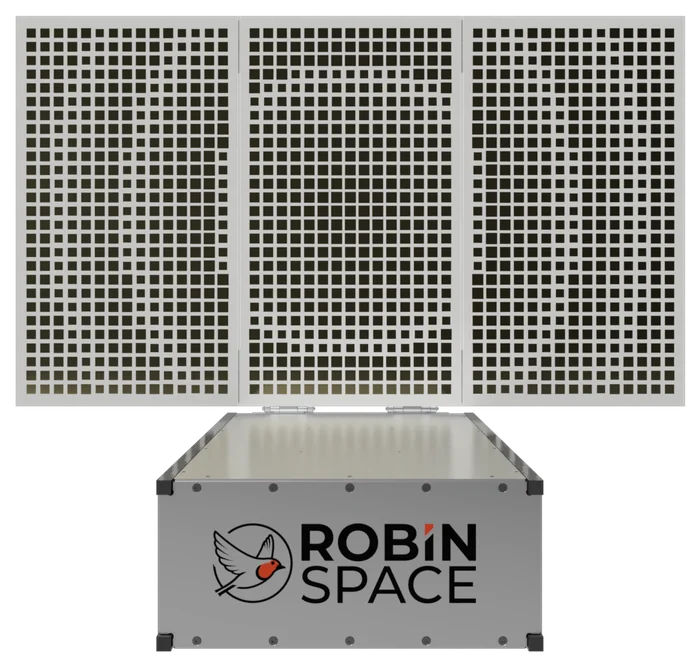
A reflectarray is a flat panel that focuses radio waves the way a curved dish does. A feed antenna illuminates the panel, and instead of a shaped metal surface doing the focusing, thousands of small printed elements on the panel each reflect the wave with a precisely tuned phase. Choose the phases correctly across the surface and the reflected wave leaves as a focused beam, exactly as if it had bounced off a parabola.
Why flat is the whole point
A parabolic dish owes its focusing to its shape, so its shape cannot be compromised, and a dish of any useful size quickly becomes the tallest thing on the spacecraft. A reflectarray owes its focusing to printed patterns, so the mechanical structure is free to be a stack of thin flat boards. Flat boards fold. An aperture of half a square meter can ride to orbit as a package a few centimeters thick against the side of the bus, then deploy into the full antenna. For small satellites, where launch volume is the scarcest commodity on board, this is the property that matters.
Reflectarray, dish, or phased array?
Against a solid dish, the reflectarray trades stowage for bandwidth. The printed elements are resonant, so a reflectarray covers its design band rather than the near-arbitrary bandwidth of bare metal; getting wide or multiple bands out of one aperture is a real part of the design craft. In exchange it stows an order of magnitude flatter, costs printed-circuit money instead of shaped-composite money, and its beam can be shaped in the design at no extra hardware.
Against an active phased array, the comparison is even simpler: a passive reflectarray needs no transmit modules, no distribution network and essentially no DC power, because the only active component is the single feed. It cannot re-steer its beam electronically the way an active array can. For the many missions that need one high-gain beam, or a handful of fixed beams, paying phased-array complexity for steering that is never used is the most expensive mistake in the trade.
Proven in orbit
The concept has flown. NASA's ISARA mission demonstrated a three-panel deployable reflectarray on a CubeSat in 2017, and the two MarCO CubeSats relayed data from the Mars InSight landing through deployable reflectarrays in 2018. Since then the technology has moved from experiment to commercial product across the industry, including on European smallsats.
Where it fits
A deployable reflectarray earns its place when a mission needs more gain than a body-mounted antenna can give, from a platform that must stay compact at launch. That covers high-rate downlinks, small SAR instruments and smallsat communications payloads, in configurations from a single center-fed panel stack to dual-surface designs that fold a long focal length into a shallow envelope. An overview of the configurations we build is on our solutions page, and the sizing question that usually comes next is treated in how much gain fits on a 12U CubeSat.
Tell us band, target gain and platform, and we return a first-cut antenna configuration.
Get in touch